Charges & Borrowings Database
Read a company's secured borrowings straight from the MCA record — every registered charge with the lender, the amount secured, creation, modification and satisfaction dates, the assets pledged, and whether the charge is open or satisfied. Sourced from MCA filings and refreshed daily.
From a company name to its complete secured-debt picture
Open any company and see every charge on its MCA record — who the charge holder or lender is, the amount secured, the date the charge was created, every modification, and whether it has been satisfied or remains open. Each charge names the assets pledged as security, so you can tell working-capital lines from term loans and debentures, gauge how leveraged the company is, and map which lenders hold security over what. Every field traces back to a filed charge document, giving credit teams, lenders and investors a direct read on secured borrowings and collateral instead of piecing filings together by hand.
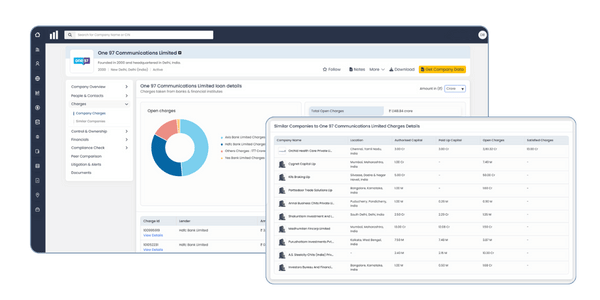
The charge holder or lender behind each charge — bank, NBFC, debenture trustee or institution — with the amount secured and the charge ID and SRN traced to the filing.
Creation, every modification and the satisfaction date for each charge, so you can follow it from registration through to closure and see what is still live.
The assets pledged as security — property, plant, receivables, stock or a floating charge — described as filed, so you can see exactly what each lender holds.
Open versus satisfied status across all charges, totalling live secured borrowings and mapping lender exposure for credit and risk assessment.
Related Pages
Navigate across connected data sources
What's Included
A practical set of fields built for screening, comparing, and understanding data.
Frequently Asked Questions
Quick answers commonly asked by users exploring this data.
What's included in a charge record? +
For each registered charge — the charge holder or lender, the amount secured, the charge ID and SRN, the creation and registration dates, every modification, the satisfaction date where closed, the assets pledged as security, and whether the charge is open or satisfied — all traced to the filed MCA charge document.
Where does the data come from, and how current is it? +
Entirely from MCA filings — the charge documents companies register, modify and satisfy on the MCA record — refreshed daily, so newly created charges, modifications and satisfactions stay current.
How do I tell live borrowings from closed ones? +
Each charge carries an open or satisfied status with its creation, modification and satisfaction dates, so you can total the charges still open as live secured borrowings and set closed ones aside.
How does this help with credit and collateral checks? +
Because every charge names the lender, the amount secured and the assets pledged, you can read a company's secured borrowings, see which lenders hold security over what, and assess collateral and lender exposure before lending or investing.